

“Hosting your outage status page on the exact same failing infrastructure you are trying to monitor is like locking the fire extinguisher inside the burning oven.”
— Dispatches from the Spinning Wheel
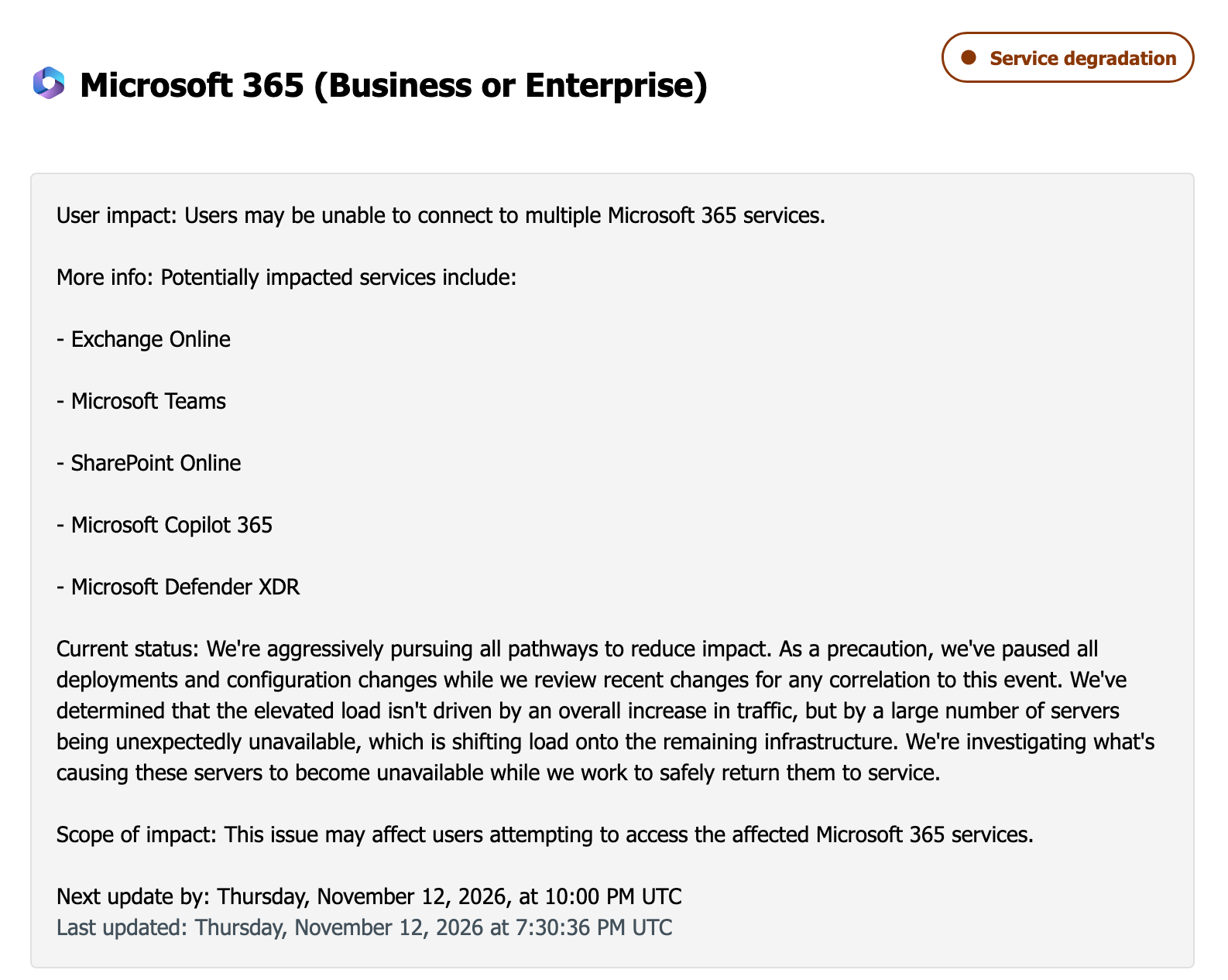
Happy Thursday, everybody. If you’re reading this instead of answering Slack-adjacent pings in Microsoft Teams or pretending to care about a spreadsheet in SharePoint, congratulations: you have survived another glorious afternoon in The Cloud™.
As of midday, Microsoft 365 has completely cratered across the Americas. Under incident IDs EX1550543 and MO1550821, Exchange Online, Outlook, Teams, SharePoint, M365 Copilot, and even Microsoft Defender XDR, (because why shouldn’t your endpoint security telemetry go blind at the exact same moment your email dies?) decided to take an unscheduled nap. According to Microsoft’s engineering notes, a massive cluster of servers abruptly began failing automated health checks, triggering a cascading overload across the remaining pool that brought the whole circus to its knees.
Peak Cloud Comedy: The Status Page Is Down
Look, outages happen. Hardware melts, BGP tables get fat-fingered, and servers fall over. What separates a normal bad day from pure, uncut comedic gold is when a platform crashes so violently that its own status page dies with it.
Nothing quite captures the majesty of “five-nines enterprise reliability” like watching thousands of systems administrators refreshing @MSFT365Status on social media because the Microsoft 365 Admin Center wouldn’t load to tell them why the Microsoft 365 Admin Center wouldn’t load. There is an ancient, sacred rule in site reliability engineering: do not host your smoke detector inside the same blast radius as the dynamite. Yet here we are, staring at HTTP timeouts while Microsoft engineers frantically hammer the rolling-restart button.
Remember That Forced Cloud Login?
Think back to the last time you installed Windows 11 and had to physically fight off nine consecutive full-screen telemarketing prompts begging you to surrender your local account, sync everything to OneDrive, and bind your existence to Microsoft 365 and Copilot.
They swore local files were relics. They swore desktop-installed software was dead weight. They swore living permanently tethered to a remote hyper-scaler server rack in Redmond was the enlightened future of productivity.
Well, guess what? My offline text editor and the local files sitting on my encrypted SSD currently have a 100% uptime SLA today. Nobody had to initiate rolling restarts on my hard drive, and my local markdown notes didn’t suffer a cascading health-check failure just because it’s a Thursday afternoon.
So pour yourself a fresh cup of coffee, close the spinning Outlook tab, and enjoy the unplanned peace and quiet. Because nothing brings humanity together quite like watching a multi-trillion-dollar cloud monopoly remind us that “the cloud” is still just a fragile pile of computers somebody else forgot to plug in.