

“Your employer just posted the highest quarterly profit margins in its fifty-year corporate history, but eliminated your entire department to fund a six-billion-dollar GPU cluster. Then HR handed you a severance PDF titled ‘Embracing Change.’ Cool! What now?”
— Notes from the Job Search Meat-Grinder | #TheJobHunt

So, you got replaced by “not AI.” Or your company quietly downsized twelve hundred people citing “macroeconomic rebalancing” and “operational efficiency,” while simultaneously announcing a massive stock buyback and boasting to Wall Street that their software margins have never been fatter. Cool!
Now you are sitting at your kitchen table, staring at a blank LinkedIn profile, wondering how you are going to make rent in ninety days. And when you venture out into the world for advice, people inevitably hit you with one of two bumper-sticker platitudes:
The Blue-Collar Pivot: “It’s never been a better time to get into the trades! Learn to weld! Become an electrician! We’ll always need human pipefitters!”
The Tech-Evangelist Cheer: “I’m so sorry, but this is a golden opportunity to adapt and innovate! Reinvent yourself! Learn to prompt! Ride the wave of the future!”
As someone who has been laid off, spent endless agonizing months staring into the algorithmic abyss of modern hiring, and had to claw his way back from scratch, I can tell you right now: I wish it were that simple.
Corporate America has discovered a wonderfully convenient sales pitch: “AI-washing” workforce reductions selling cost cutting as technological destiny. The layoffs are real. Whether every eliminated role has actually been replaced by a capable AI system is another matter. And while the ultimate societal impact of generative AI will settle somewhere between the breathless hype of Silicon Valley venture capitalists and the doom-saying of Luddites, the ground is shifting beneath our feet at terrifying speed.
The Ghost of the Ice Cutters
A while back, I wrote an article reflecting on a nearly forgotten historical profession: the Ice Cutters.
During the nineteenth century, harvesting natural ice became a major business. Workers marched onto frozen lakes in New England with horse-drawn ice cutters, carved blocks of frozen water out of the earth, packed them into insulated ships, and transported them across the globe just to keep food cold. It was a massive, physically demanding, capital-intensive enterprise built around the extraordinary business model of shipping winter to people who didn’t have any.
Then mechanical refrigeration arrived. Manufactured ice and, later, household refrigerators spent decades dismantling the business of dragging winter around in blocks. The ice cutters didn’t lose their jobs because they were bad at sawing ice. They lost their jobs because the technology moved on.
Generative AI threatens to bring a version of that disruption to white-collar knowledge work across a hell of a lot more than one industry. The people selling it would like the transition to happen at the speed of light. Your mortgage company will presumably be very understanding about the historical significance.
The Mirage of the Trades
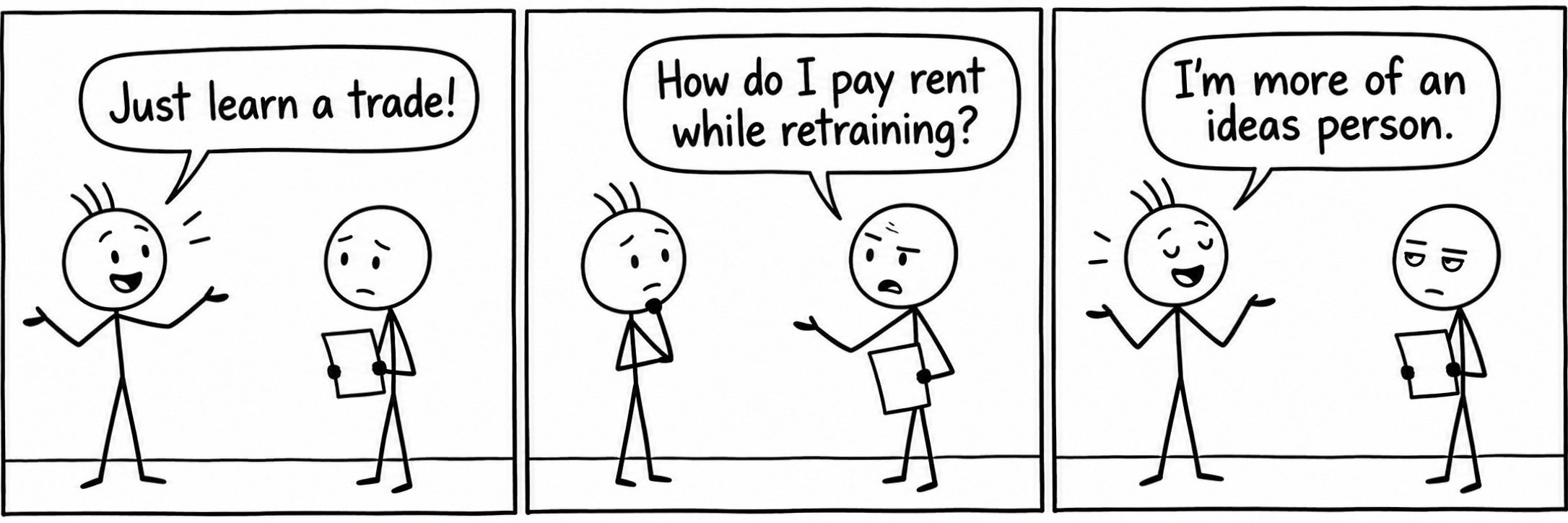
When well-meaning friends tell you to “just go learn a trade,” I urge you to take a long, cold breath before you burn your savings on welding academy tuition.
Yes, there is real demand in skilled trades. The Bureau of Labor Statistics projects growth for electricians and plumbers and pipefitters. And yes, there is an honest, tangible, deeply satisfying dignity in working with your hands rather than staring at a glowing IDE all day until your retinas sizzle.
But do not be naive about the corporate roadmap. The effort to automate work extends into embodied physical robotics. In China, people are already getting paid to film themselves doing household chores so robots can learn them. Your new side hustle can apparently include recording the training manual for your eventual replacement. I cannot tell you when general-purpose robots will be able to handle the work of a plumber or an electrician, but assuming manual physical labor is a permanent, impenetrable fortress against automation is historical blindness.
Worse, consider the difference between a recruitment slogan and an actual job offer. We were sold a cybersecurity gold rush, complete with headlines promising 3.5 million unfilled jobs. Meanwhile, ISC2’s research documents unrealistic requirements for early-career hires. Apparently, needing more security staff and being willing to hire someone who needs training are two entirely separate corporate religions. I have colleagues in my peer network, smart, certified, capable security practitioners, who gave up on InfoSec entirely after six months of ghost job listings and went into nursing just to secure a predictable paycheck.
There is also a small logistical inconvenience: an opening for an experienced pipefitter is not a job offer for someone who got laid off from product management on Tuesday. Plumbing apprenticeships generally take four or five years. If displaced office workers chase the same limited training slots, getting trained may be the first bottleneck. If qualified supply eventually outruns local demand, wages could come under pressure. “Just learn a trade” is not a national employment policy.
The Trap of “Reinventing Yourself”
On the flip side, the techno-optimist advice, “Just reinvent yourself as an AI creator!” is its own brand of toxic delusion.
The barrier to producing something has collapsed to the floor. When people can prompt an app prototype, generate a video clip, or crank out marketing copy in minutes, the world gets flooded with an unceasing, deafening tsunami of synthetic noise. How do you stand out when everyone else in your market can get their hands on the same god-tier creative tools? Finding an organic niche in an ocean of automated mediocrity is grueling, exhausting work.
You should still learn the tools. aignoring them is professional suicide but don’t expect “AI proficiency” to be an automatic golden ticket when your retired uncle and your twelve-year-old cousin are already generating code on their tablets.
Unsolicited Advice from the Trenches: How to Actually Survive
At this point, you’re probably thinking: “Thanks for the existential dread, man. That was a lot of negative energy and zero help in paying my rent.”
Fair point. Having lived through the meat-grinder of prolonged unemployment and job hunting, here is my raw, unfiltered, battle-tested advice for anyone stranded in the wilderness right now:
1. Do Not Stop Looking (Even When the System Is Hallucinating)
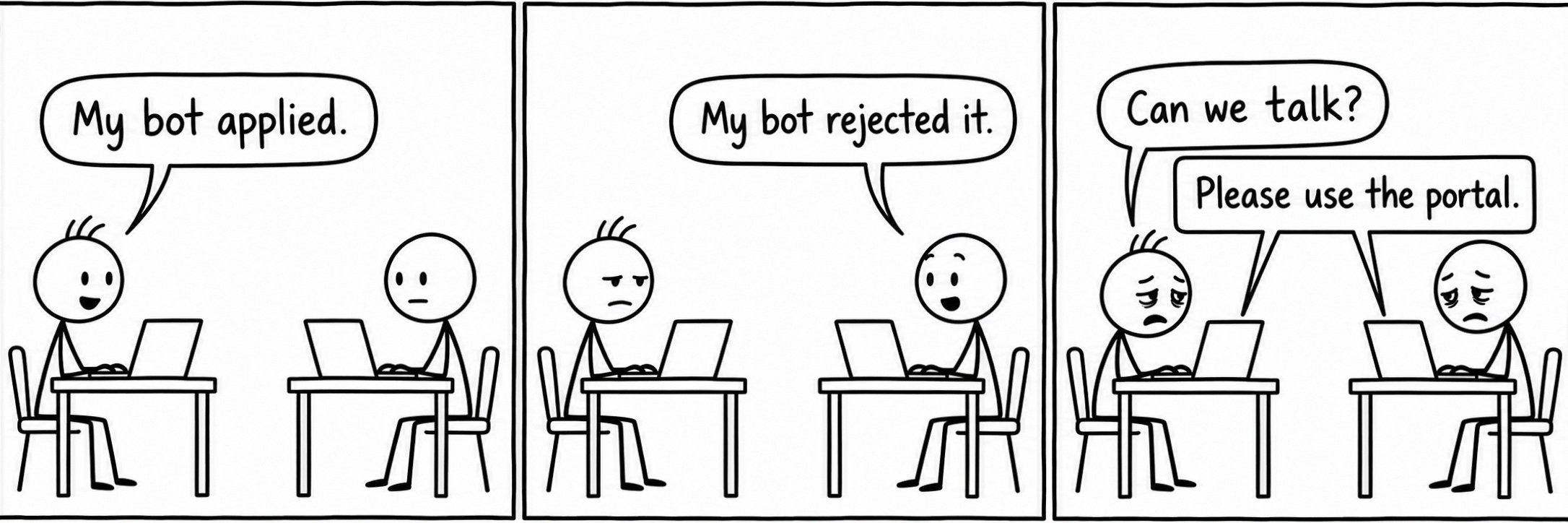
The modern hiring landscape is an algorithmic fever dream. Applicants can automate the application process, recruiters can screen and filter submissions before speaking to a candidate, and vendors are literally selling AI video avatars to conduct early-stage interviews with human beings. Somewhere in this process, two humans are allegedly trying to meet. It is degrading, absurd, and demoralizing. Do not internalize the silence. Being filtered out or simply never getting a response is not a verdict on your human competence.
2. Network Like a Maniac (Despite LinkedIn Being a Toxic Wasteland)
I am not an extrovert. I despise corporate small talk, and LinkedIn has devolved into a radioactive landscape of hustle-culture influencers congratulating themselves on waking up at 4:00 AM to drink room-temperature ghee. But in a hiring market drowned by synthetic resumes, a direct human connection can still pierce the veil. Talk to former colleagues. Message engineers whose work you admire without immediately begging for a referral. Cast your net wide.
3. Swallow Your Pride and Pivot Sideways
When I was fighting to break into healthcare, I worked as a medical assistant in clinical healthcare for half a year. It had zero prestige. It paid terrible wages compared to what I was making as an engineer. It was physically demanding. But it placed me directly inside the physical ecosystem of a massive regional hospital network which eventually allowed me to transition into their enterprise IT and security infrastructure. Healthcare in the United States is a convoluted, bureaucratic mess, and AI is creeping into diagnostic workflows, but at least at the end of the day you are doing something real that directly helps a living, breathing human being. Do not be afraid to take a humble detour to get your foot in an institutional door.
4. Hack Trade Shows for Free Passes
Some commercial conferences and industry expos cost hundreds or thousands of dollars that you don’t have when you’re unemployed. Before you pay, ask exhibitors whether they have an unused complimentary floor pass. Reach out to developer advocates, sales reps, or marketing managers on LinkedIn or email: “Hey, I’m an engineer looking for my next role, any chance you have an extra vendor floor pass?” You’d be shocked how often they say yes. Look for affordable local meetups and community events, too. A fifteen-minute coffee conversation can get you further than another evening of clicking “Easy Apply” into the void.
5. Grieve, Rage, and Accept That It Fucking Sucks
We live in an intensely unfair economic machine, and it is getting more cutthroat by the hour. Losing a job isn’t just about financial stress and panic over health insurance; it attacks your fundamental identity, your pride, and your basic human desire to feel useful. Do not bottle that poison up. Grieve it. Be angry. And then wake up tomorrow and keep moving. If you are going through this right now, hit me up on spydr.io. I see you, and you are not alone.
The True Crisis: The Age of Mistrust
This struggle isn’t just about cybersecurity or software engineering. It is about a profound, tectonic shift in our cultural foundation. We have officially crossed the threshold from the Age of Information into the Age of Skepticism and Mistrust.
Nobody trusts what they see on screen. Recruiters assume every resume is an LLM fabrication. Candidates assume every job listing is a ghost posting meant to placate investors. Users assume every piece of art or code is synthetic sludge. The fundamental fabric of human trust has frayed.
If you can build something in this world, a community, a protocol, a business, or an honest relationship, that actually helps human beings trust each other again, you won’t just be the richest person on Earth. You will be the most loved. Because right now, what we all need more than faster models, cheaper compute, or automated scripts, is a little more trust in each other.