


“Part of me hopes they really are just dorky scientists trying to do their best with an unimaginable power. The cybersecurity engineer in me dreads what their machines are about to find.” -Hackernews
If you aren’t a math nerd, there is a very good chance you scrolled right past the couple dozen headlines last week about how Anthropic and Turkish-American number theorist Levent Alpöge dropped a massive computer-verified proof of the Generalized Riemann Hypothesis; an announcement so surreal that complexity theorist Scott Aaronson literally titled his reaction post “The stochastic parrots have apparently proved the Riemann Hypothesis.”
And you definitely scrolled past what happened three days later, when Anthropic quietly pushed a 70-page paper and 73,000 lines of formal Lean 4 code to their GitHub repository claiming a proof for VP ≠ VNP over every field, listed with Claude (Anthropic) as the sole author, accompanied by a delightfully terrifying README casually informing the world that no human mathematician had actually checked it yet.
Hell, you might have just read “VP ≠ VNP over every field” and felt your eyes glaze over like a stale Krispy Kreme donut. I don’t blame you. Most normal human beings do not wake up on a Monday morning burning with curiosity about arithmetic circuit lower bounds for the permanent polynomial.
You should care anyway. Because these back-to-back mathematical bombshells aren’t just ivory-tower flexing from an AI lab looking for prestige. They carry massive implications for the future of cybersecurity and if you zoom out to thirty thousand feet, they give us a flashing, neon-lit clue about the final boss Anthropic appears to be throwing its entire compute cluster at right now: the P versus NP problem.
So What the Hell Is P vs. NP, Actually?
Editor’s note: If you already know what P = NP is and can explain polynomial-time verification over beers without breaking a sweat, feel free to skip this section and jump straight to the next one.
In mathematics and computer science, there is a legendary, unsolved monster called the P versus NP problem. It carries a $1 million bounty from the Clay Mathematics Institute, though honestly, anyone who solves it probably won’t care much about the million bucks once they’re done rearranging the global economy.
Stripped of all the academic Greek letters, the problem is asking one deceptively simple question: Is there a fast way to solve every problem whose answer can be checked quickly?
Let’s break down the two buckets:
P (Polynomial Time) is the bucket of problems a computer can solve easily and quickly. Alphabetizing ten million names, multiplying two massive prime numbers together, or calculating the shortest route from Denver to Chicago on Google Maps. As the input gets bigger, the time your laptop needs to grind out the answer grows at a polite, manageable pace.
NP (Nondeterministic Polynomial Time) is the bucket of problems where finding the answer from scratch might take a supercomputer until the heat death of the universe. However, once someone hands you a proposed answer, you can verify whether it’s right in half a second.
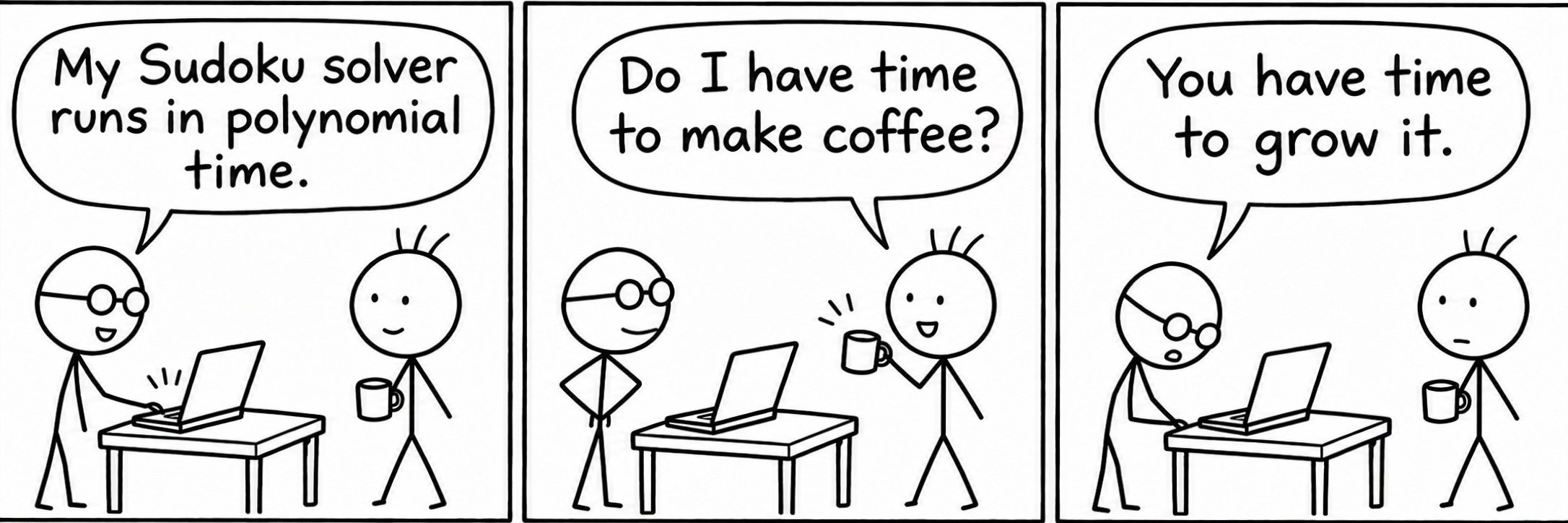
Think of a gigantic, sadistic 1,000-by-1,000 Sudoku grid. Sitting down to solve that monstrosity from scratch is pure misery; the branching possibilities explode exponentially until your brain melts out of your ears. Now imagine your smug coworker walks up, slaps a completed grid onto your desk, and says, “Nailed it.” How long does it take you (or a five-line Python script) to check every row, column, and box to verify they didn’t cheat? Seconds.
Or think of a 50,000-piece jigsaw puzzle of a plain blue sky. Assembling it makes you want to flip the dining room table through a sliding glass door. Walking into the room and confirming it’s put together correctly takes one glance. Multiplying two 300-digit prime numbers together takes a cheap laptop a millisecond (easy). Handing that same laptop the 600-digit result and asking which two prime numbers produced it? Good luck and come back after the sun expands and incinerates Earth.
Common sense screams that P does not equal NP. Obviously solving a hard puzzle is fundamentally harder than grading the answer key! Every mathematician, computer scientist, and security engineer on the planet operates on the gut-level assumption that P ≠ NP. The catch? After more than fifty years of the smartest humans alive banging their skulls against chalkboards, nobody has actually been able to prove it.
Now, before we hit the panic button, there is one giant piece of fine print you need to keep in mind. Even if someone proves tomorrow that P = NP, the world only goes sideways if the proof is practical.
Math is full of cruel jokes. It is entirely possible to prove that a fast algorithm exists non-constructively, basically proving there’s a golden treasure chest somewhere on Earth without leaving a map. Worse, you could discover a technically “polynomial” algorithm whose runtime scales as something absurd like n^(10^100). Computer scientists call those galactic algorithms: mathematically “efficient” on a whiteboard, utterly useless in physical reality because they’d still outlast the universe for any input bigger than your PIN code.
For the world to truly break, a P = NP proof would have to hand us a constructive, low-degree, practical algorithm you can actually compile and run on real silicon. And if that ever happens? Buckle up. Because the world and frankly, what we thought we knew about the universe gets profoundly weird.
Welcome to Algorithmica: What a Practical P = NP Means for the World (and the Universe)
Let’s start with the utopian sci-fi upside, because it’s genuinely breathtaking. If P = NP and the algorithm is practical, almost every brutal optimization bottleneck holding humanity back evaporates overnight.
Take medicine. Checking whether a specific three-dimensional protein folds correctly to bind to a cancer cell receptor? Relatively straightforward to simulate and verify. Finding the exact sequence of amino acids that produces that miracle molecule out of astronomical combinations? Horribly hard. In a practical P = NP world, you describe the biological lock, hit Enter, and out pops the exact molecular key. Curing Alzheimer’s, neutralizing antibiotic-resistant superbugs, designing room-temperature superconductors, optimizing global power grids, routing every cargo ship and airplane on Earth with zero wasted fuel, all of it turns into an afternoon compute job.
Even more bizarrely, mathematics itself gets a speed-run to the credits screen. Checking whether a mathematical proof is logically valid, the exact thing formal proof assistants like Lean do is fast and mechanical. Discovering the proof in the first place is what turns human geniuses into legends. If P = NP practically, finding a short proof for any provable mathematical theorem becomes an automated button click. Every single unsolved conjecture with a reasonably sized proof collapses before lunch.
Pause for a second and let what that actually implies about the universe sink in.
Scott Aaronson summed up the cosmic weirdness better than anyone ever has:
“If P = NP, then the world would be a profoundly different place than we usually assume it to be. There would be no special value in ‘creative leaps,’ no fundamental gap between solving a problem and recognizing the solution once it’s found. Everyone who could appreciate a symphony would be Mozart; everyone who could follow a step-by-step argument would be Gauss.”
Right now, our entire reality is built on asymmetry. Biological evolution took billions of years of blind, brutal search to stumble onto an eyeball, even though testing whether an eyeball helps an animal avoid getting eaten takes one afternoon. Writing a masterpiece novel takes years of tortured brilliance; recognizing it as a masterpiece takes a weekend on the couch. Mystery exists in our universe precisely because searching a massive haystack is supposed to be infinitely harder than recognizing the needle once it’s sitting in your palm.
If P = NP is true in a practical way, that asymmetry is an illusion. Creativity isn’t sacred; it’s just fast search. Nature has no real locked doors, only locks we were too dim to notice were actually unlatched the entire time.
Oh, and right before we get around to curing cancer and having a Dell laptop churn out Beethoven’s Tenth Symphony, every single piece of modern cybersecurity catches fire and burns to the waterline.
The Cybersecurity Apocalypse: Every Lock Turns to Wet Cardboard
If you work in infosec, your entire career is built on one foundational mathematical premise: one-way functions exist.
A one-way function is a mathematical trapdoor. Effortless to drop through in one direction, functionally impossible to climb back out of without the secret key. Scramble a message with AES-256? Easy. Reverse the ciphertext back to plaintext without the key? Impossible. Run your password through SHA-256 or Argon2? Takes a blink. Figure out which password produced that hash? Good luck burning through the Sun’s entire energy output trying.
Here is the terrifying part that separates a practical P = NP scenario from everything else security teams currently lose sleep over. For the last five years, we’ve all been bracing for “Q-Day”, the moment fault-tolerant quantum computers run Shor’s algorithm and snap RSA and Elliptic Curve Cryptography (ECC) in half. That’s a massive headache, sure, which is why NIST spent years standardizing Post-Quantum Cryptography (PQC) built on lattice math, and why symmetric encryption like AES-256 and hashes like SHA-256 mostly shrug off quantum computers by just doubling key sizes.
A practical P = NP algorithm doesn’t give a damn about Post-Quantum Cryptography. It doesn’t care about lattices. It doesn’t care about AES-256, ChaCha20, SHA-3, or zero-knowledge proofs.
Why? Because breaking every single modern cryptographic algorithm is an NP problem. Hand me a ciphertext and a candidate key, and I can check in microseconds whether that key decrypts the payload into a valid TLS handshake or readable JSON. Hand me a Bitcoin wallet address and a candidate private key, and verifying the match takes nanoseconds. If finding an answer becomes just as easy as checking one, one-way functions mathematically cannot exist.
In computer scientist Russell Impagliazzo’s famous “Five Worlds” framework, civilization drops straight into a nightmare realm called Algorithmica, where computational cryptography simply dies:
TLS, HTTPS, SSH, and VPNs evaporate. There is no longer any secure way to establish an encrypted connection with a bank, hospital, or server across an untrusted network.
Every digital signature becomes forgeable. Windows Update, iOS firmware, code-signing certificates, Certificate Authorities, Kerberos tickets, JWTs, anyone with the solver can forge a mathematically valid signature from Apple, Microsoft, or the Federal Reserve in seconds.
“Harvest now, decrypt later” becomes “decrypt everything right now.” Every encrypted diplomatic cable, corporate secret, medical record, and Signal backup vacuumed off undersea fiber lines by intelligence agencies over the last thirty years turns into plaintext before dinner.
Every blockchain goes to zero instantaneously. If you can derive any private key from a public key on demand, Bitcoin, Ethereum, and every decentralized ledger on Earth gets drained in a single block.
The only encryption left standing in a practical P = NP universe is information-theoretic security or basically the One-Time Pad, which is unbreakable even with infinite compute power. The catch? To use a One-Time Pad, you need a truly random secret key that is just as long as the entire message you want to send, you can never reuse a single byte of it, and you have to physically hand it to the other person in advance, like a Cold War spy with a briefcase handcuffed to his wrist. Try running modern e-commerce, cloud infrastructure, or global banking on courier-delivered paper pads. You can’t. The internet as a commercial and social utility ceases to exist.
Inside the “Mathocalypse”: Why Anthropic’s Breadcrumb Trail Matters Right Now
So why am I dragging you down a theoretical computer science rabbit hole right now? Because suddenly, this stopped being a dusty thought experiment from a 1990s college textbook.
Look at the sequence of events Anthropic just dropped over a single seventy-two-hour stretch:
First, on Friday, November 20, Levent Alpöge, a number theorist on Anthropic’s staff announced that after six weeks working alongside an unreleased Claude model, they had produced a formal Lean proof of the Riemann Hypothesis and the Generalized Riemann Hypothesis. Not a neat thirty-page manuscript you read with a highlighter, mind you: a sprawling machine-checked codebase of roughly 175,000 files and 17 million lines of Lean code. Alpöge famously noted that near the finish line, “Claude flew, and danced, and sparkled.” And why does GRH matter to complexity theorists? Because it governs the deepest patterns of prime numbers and sits directly underneath huge swaths of algorithmic number theory and deterministic complexity.
Then, literally three days later, Anthropic pushed the vp-vnp directory into anthropics/formal-math repo. 73,000 lines of Lean 4 code and a 70-page paper authored entirely by Claude claiming to prove Leslie Valiant’s 1979 conjecture: VP ≠ VNP over every field. If P vs. NP is the heavyweight championship of Boolean logic circuits, VP vs. VNP is its direct, blood-related algebraic sibling, asking the exact same question about polynomials, determinants, and arithmetic circuits. That came right on the heels of Anthropic models helping crack quantum complexity barriers like the Aaronson-Ambainis conjecture earlier in the year.
If you want a front-row seat to the collective existential vertigo this is causing across tech and academia, spend twenty minutes scrolling through the Hacker News discussion on Anthropic’s VP ≠ VNP release.
The thread is a fascinating mix of awe, razor-sharp skepticism, and quiet dread. A few huge themes immediately jumped out:
The “Statement Verification Gap”: Yes, the Lean 4 compiler and independent secondary verification kernels like
nanodaconfirm the 73,000 lines compile with zero logical leaps under standard foundational axioms (propext,Quot.sound, andClassical.choice). But as Anthropic’s own README candidly warns, and as HN commenters immediately hammered home, Lean checks that the proof follows from the definitions, not that the definitions actually match what humans mean. If an AI subtly defines a toy or broken version of an “arithmetic circuit” insideStatement.leanand proves a watertight theorem about that, Lean will cheerfully flash a green checkmark while the real problem remains untouched. Human experts still have to audit the translation layer line by line.Non-Constructive Loopholes and Complexity Barriers: Mathematicians on HN and MathOverflow immediately zeroed in on how the proof relies on
Classical.choice(the Axiom of Choice) and non-constructive arguments, sparking fierce debate over whether machine reasoning is finding alien ways to route around famous human roadblocks like the Razborov-Rudich “natural proofs” barrier, and whether any of those algebraic tricks can actually jump the chasm over to classical Boolean P vs. NP.The “Only the Machines Can Read” Problem Returns: Just like we talked about last week with AI-generated enterprise infrastructure, Fields Medalist Terence Tao has been warning about a “Mathocalypse” buried under impenetrable mountains of machine-verified code that no human mathematician can fit inside their head. Even if every single line of a 17-million-line proof compiles, human specialists might need years just to extract the actual conceptual why out of the alien machinery Claude built.
Anthropic explicitly cautioned in their repo that proving VP ≠ VNP does not solve classical P vs. NP. And they haven’t held a flashy press conference declaring a Manhattan Project to settle P vs. NP once and for all.
They don’t have to. When an AI lab systematically clears quantum complexity conjectures, drops a 17-million-line bomb on the Generalized Riemann Hypothesis on a Friday, and knocks out the algebraic cousin of P vs. NP on a Monday morning, you don’t need a leaked memo to read the room. From a high-level view, it sure looks like Anthropic is throwing the entire kitchen sink and every drop of reasoning compute they can spare at taking down the biggest open problem in computer science.
Dorky Scientists, Unimaginable Power, and a Security Engineer’s Dread
Now, an optimist might point out a comforting irony here: Claude’s VP ≠ VNP proof actually points in the safe direction! If Anthropic eventually throws enough compute at P vs. NP and comes back with a formal Lean proof that P ≠ NP, every cryptographer on Earth pops the expensive champagne, right? We finally get mathematical confirmation that hard problems really do exist!
Not so fast. Because as a security engineer, I don’t just worry about the worst-case binary outcome where P = NP. I worry about everything that falls out of the tree while you’re shaking it that hard.
The mathematical problems protecting your bank account, your SSH keys, and your encrypted messages and things like integer factoring, discrete logarithms, and lattice shortest-vector problems, aren’t even proven to be NP-complete. Most cryptographers suspect they live in a spooky twilight zone called NP-intermediate. Which means an AI cluster doesn’t even have to prove P = NP to shatter modern encryption. It could prove P ≠ NP on Tuesday and accidentally discover a sneaky, classical, polynomial-time factoring shortcut on Wednesday afternoon.
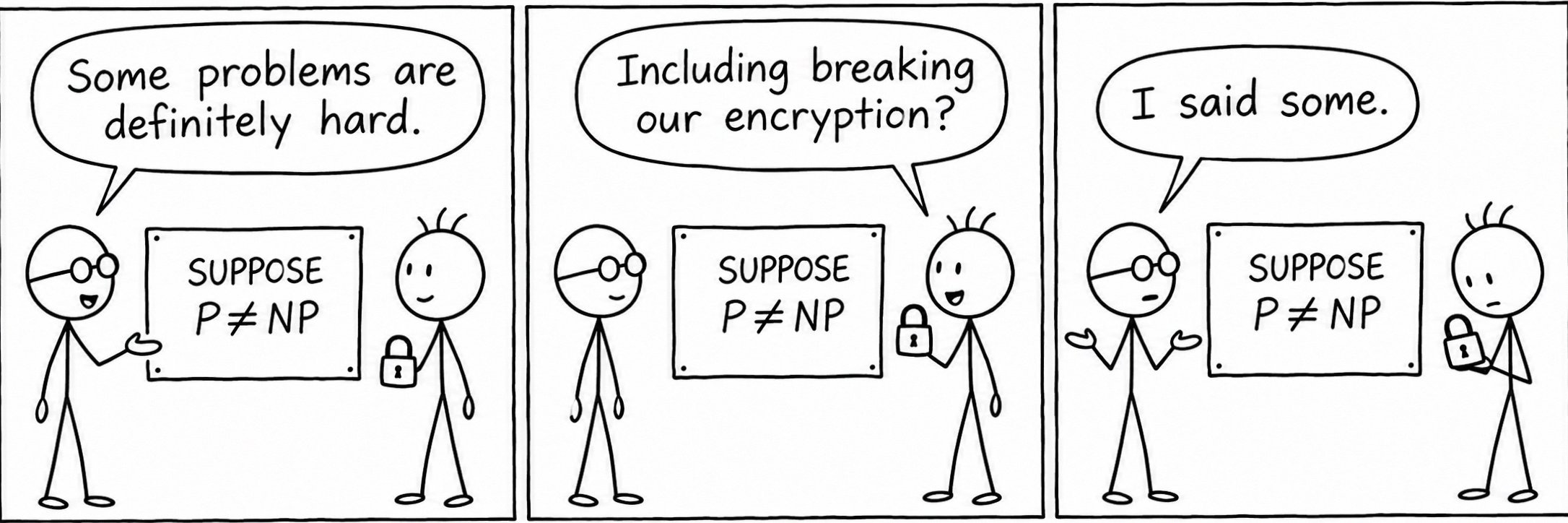
And if, against every intuition humanity has held for half a century, an unreleased frontier model grinding through ten billion tokens inside a locked data center actually stumbles onto a constructive proof that P = NP or even just a clean algorithmic skeleton key for RSA, ECC, or AES, stop and think about what happens in the sixty seconds after the terminal prints Q.E.D.
Does an AI lab push that to GitHub on a Monday morning with a cheeky note saying “no human has checked this yet”? Does the board of directors call the White House before they even tell their own safety team? Does the NSA kick the server-room door off its hinges before the weights finish checkpointing?
Look, I genuinely want to believe the best about the researchers inside Anthropic. My sincere hope is that they really are exactly who they present themselves to be: a bunch of brilliant, slightly dorky scientists trying to do the right thing while holding the reins of an unimaginable, reality-warping power.
But the cybersecurity engineer in me, the guy who spends his life staring at the rusted locks and duct-taped cryptography holding modern civilization upright, can’t shake a cold, quiet dread in the pit of my stomach about what those machines are going to dig up next.